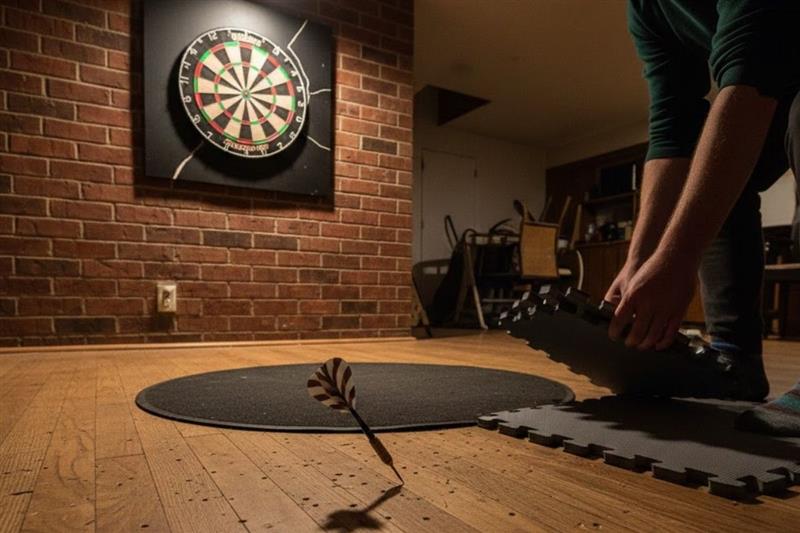
Your hardwood floor doesn’t care that you got a bullseye. It cares about the three darts that bounced off the board and left tiny craters where they landed. A floor mat for darts isn’t some luxury item for people with money to burn. It’s the difference between playing darts and asking, “How many holes can I put in my floor before someone notices?”
Darts Destroy Floors, Actually
People think darts are harmless because they’re small. They’re wrong. Those tungsten tips hit the floor traveling fast enough to leave marks in tile, dents in hardwood, and bent tips on concrete.
Each dart weighs maybe 20 grams but that weight concentrates into a needlepoint. When it drops from chest height, there’s enough force to damage most surfaces. I’ve seen garage floors with dozens of pockmarks from months of casual play. The carpet looks safe until you realize dull tips bounce out of the board more often. More bounce outs mean more floor hits. More floor hits make tips duller. You’re stuck buying new points every few weeks.
What These Mats Actually Are
Most are rubber, about 10 feet long and a couple of feet wide. Thick enough to catch darts without letting them through. The good ones have a marked throw line so you’re not guessing where to stand. Some fold up like yoga mats. Others roll.
The rubber ones stay flat once you lay them out. Foam ones sometimes curl at the edges, which gets annoying. Thickness ranges from super thin to about half an inch. Thin ones are easier to store. Thick ones protect better and don’t slide around when you step on them. Around 6mm works for most people.
The Throw Line Thing
The official distance is 7 feet 9.25 inches. Soft tip uses 8 feet. It doesn’t matter which one you pick; just stay consistent. Your brain learns muscle memory at one distance. Change it constantly, and your aim goes to hell. I played at different distances for months before figuring out why I couldn’t hit anything reliably. A floor mat for darts has the line already marked. Same spot every time you roll it out.
Your accuracy improves because you’re not constantly adjusting. Some mats have a little raised bump at the throw line. You feel it with your foot. Sounds dumb, but it helps. You know exactly where you’re standing without looking down.
The Real Benefits Nobody Talks About
Sure, floor protection’s the obvious reason to get a mat. But there’s other stuff that matters just as much. Your darts last longer. When they hit rubber or foam instead of hardwood, the tips don’t bend or dull as fast. You’re not replacing points every month or sending darts in for repairs. Noise reduction is huge if you live in an apartment or play late at night. A dart hitting a bare floor sounds like someone dropping a fork at 2 AM.
A mat absorbs most of that sound. Your downstairs neighbors will thank you, or at least stop complaining. The mat defines your playing space. When you roll it out, that’s dart territory. When you roll it up, the room’s back to normal. If you share space with roommates or family, that matters more than you’d think.
What Size Do You Actually Need
Conventional mats are approximately 10 feet by two feet. That covers most situations. If you’re playing tight with the space or know that it will mostly be just you using the board, then perhaps you can get away with something smaller. A wide dart mat is practical (in case more than one person plays or if the people throwing darts are a little rambunctious). Extra width to catch more bounce-outs.
It also permits moving side to side without stepping off the mat, which some people like. Length matters too. If your board is mounted low or you have kids playing, darts go into the floor closer to the board. The longer the mat, the more coverage. Some mats stretch 12 feet or more for true setups. Measure your space before buying. Too much mat and you might trip, overshooting the edge. Too little and you’re missing the point.
Custom Stuff
Custom floor mats for dart setups cost more, but some people need specific sizes. Odd-shaped rooms, commercial bars, team logos, whatever. Takes a few weeks to make. Not cheap. But if you’re building a dedicated space or you need something non-standard, custom is the only option that works.
Wall Protection’s Different
A dart mat for wall mounts behind the board to catch really bad throws. A different product entirely. Usually cork or foam. If you’re teaching beginners or your aim is still developing, wall protection saves your drywall. I’ve patched enough holes to know this firsthand. Most experienced players don’t bother. But households with multiple skill levels probably want both wall and floor coverage.
Taking Care of It
Rubber mats just need wiping down occasionally. Foam and carpet need more attention. Vacuum carpet mats every couple of weeks, or they get gross. Storage is easy. Roll it up, stick it somewhere. Behind a door, in a closet, leaning against a wall. Takes up less space than a yoga mat. Don’t store it wet. That’s how you get mold and smells that don’t come out. Let it dry completely first.
What You’ll Actually Pay
Cheap mats are in the $30 to $40 range. They’re thin, most commonly in rubber, and they do just fine for casual play. Mid-range mats cost 50 to 80 dollars. That’s where you find better materials, cushier padding, and nicer designs. High-end mats are also available and can cost 100 dollars or more. You’re paying for the fine materials, professional-grade construction, and perhaps some customization.
For most, this level isn’t necessary unless they are competing or operating a commercial operation. For home use, spending 60 to 75 bucks gets you something solid that’ll last years. Don’t cheap out and buy the thinnest mat you can find. It won’t protect as well, and you’ll end up replacing it sooner.
Do You Need One?
Playing more than once a month? Yeah, get a mat. Replacing dart tips and fixing floors costs way more than 60 bucks. Playing occasionally and don’t care about consistency? Maybe skip it. But honestly, for the price, why not just get one? The marked throw line alone makes you better over time—muscle memory locks in at one distance. Your accuracy actually improves instead of staying random.
The Bottom Line
A floor mat for darts does three things. It protects your floor from damage. It protects your darts from wear. And it gives you a consistent throw line, so your game actually improves instead of staying stuck. You can spend 40 bucks on a basic mat or 100 on something fancy. Either way, it’s cheaper than fixing floors, replacing bent dart tips, or guessing your throw distance every time you play. Roll it out when you play. Roll it up when you’re done. Simple as that.





💬 Comments