You know that smell. The one where you’re halfway through straightening and your bathroom smells like someone had been microwaving popcorn for a few minutes too long. That smell is of your hair proteins literally cooking. Not metaphorically. Actually cooking. Happened to me in college. Took my roommate’s flat iron and cranked it to max because I was late. Smell hit me first. Then I noticed the smoke. Small, tiny wisps that were coming off my hair like I was a human barbecue. It cost me $200 at the salon to repair what I accomplished in five minutes.
What Actually Breaks When You Use Heat
Hair is about 85% keratin protein. These proteins line up in an alpha-helix shape, like tiny springs. Hydrogen bonds hold everything together. According to studies on PubMed, this is the critical temperature at which reversible damage becomes irreversible. Your flat iron may be around 300°F and 450°F; most blow dryers reach temperatures ranging from 140°F to 200°F. Do the math. When you reach that point of 284°F, your alpha-helix structure turns into beta-sheets.
Sounds technical, but in simple terms, your hair transforms from stretchy and pliable to brittle and stiff. Like overcooked pasta versus al dente. Scientists at Hiroshima University learnt how to observe this in real time using synchrotron radiation. They observed clumps of keratin proteins clumping together and suspending, exactly like eggs hardening when you boil them. Can’t undo that. Once those proteins denature, they stay that way.
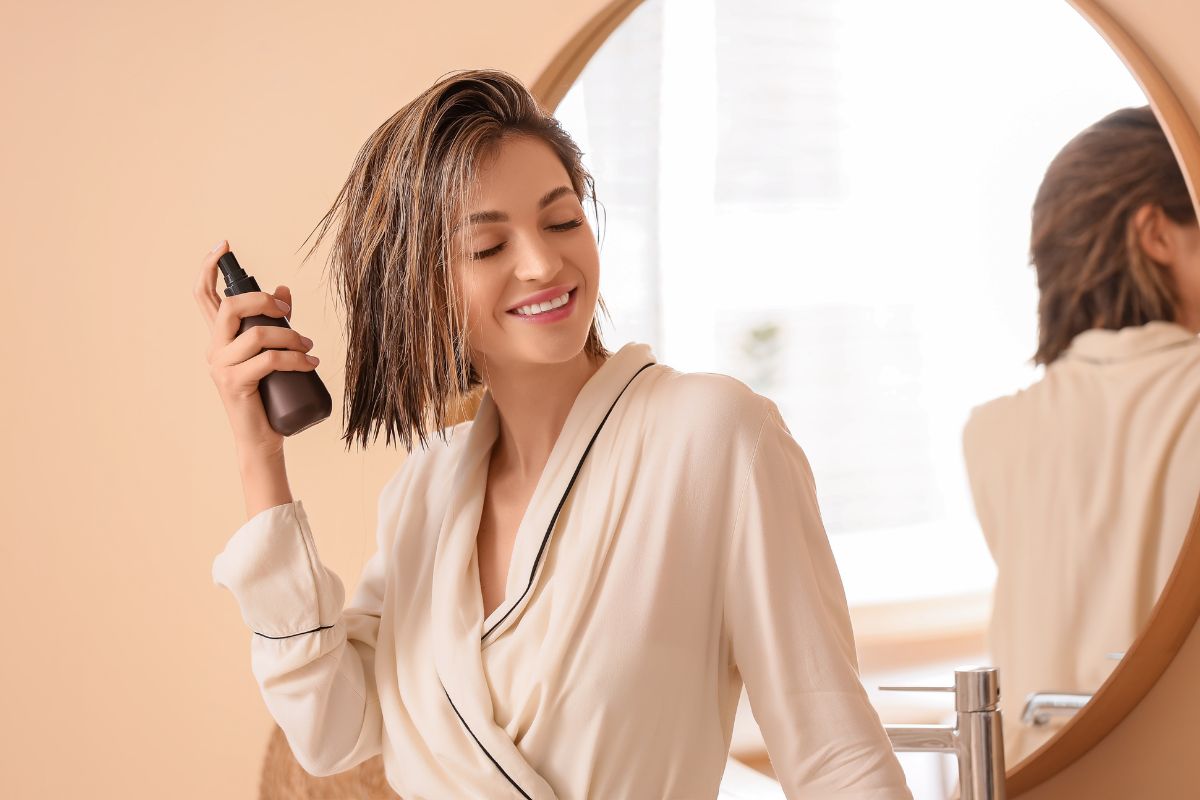
How Heat Protection Spray For Hair Actually Works
Here’s where it gets interesting. The silicones in these sprays build up on your hair. They form what chemists describe as a thermostable barrier. In a study from the National Institutes of Health, crystallin fusion proteins were applied to hair before heat treatment. Hair dyed with the proteins also held onto 38% to 44% more water after heating than hair left untreated. Water content matters. When your hair loses moisture, it becomes more vulnerable to heat damage.
The stiffness heightens by about 10%, according to that same research. Commercial heat protectors are formulated with various molecular-weight silicones. For example, Small molecules (less than 1000 Daltons) can penetrate further into the hair shafts.” Larger ones stay on the surface and form a protective film. Think of it like sunscreen. SPF 30 doesn’t indicate that you should stand in the sun indefinitely. It means you have a little bit of protection. Same deal here. Most products reduce damage by 50% to 70%, depending on the formula. That’s according to testing done at temps around 350°F to 400°F.
Also Read – Why Everyone’s Suddenly Wearing Green Wool Coats This Winter
Different Hair Needs Different Protection
Got fine hair? Heavy creams will make you look greasy by noon. My cousin has super-thin blonde hair. She tried this thick argan oil spray once and looked like she hadn’t showered in a week. Fine hair needs lightweight sprays. Something that evaporates fast and doesn’t leave residue. Thick or coarse hair can handle heavier formulas. Actually needs them. Those hair shafts are bigger and need more coverage. Curly hair’s trickier. Usually drier to begin with because natural oils can’t travel down the curves.
So curly folks need moisture plus protection. Leave-in conditioners that double as heat protectants work well here. Color-treated hair? You need UV filters too. Heat’s not your only enemy. Sun fades color just as badly. Maybe worse because you don’t feel it happening.
The 450 Degree Marketing Lie
Every bottle screams it can protect up to 450°F. Makes you feel invincible. But research shows structural changes start at 284°F. That’s way below what your tools probably run at. The spray buys you insurance, not immunity. You still need to be smart about temperature settings. My hairstylist never goes above 350°F on clients. She’s been doing this for fifteen years. Says anything higher is just asking for trouble, protectant or not.
The Myths You Need To Stop Believing
Myth 1: “Natural oils work just as well.” They don’t. Coconut oil has a smoke point of around 350 degrees. That’s decent. But it doesn’t form the protective coating that commercial products do. Use it as a finishing oil, not a heat protectant.
Myth 2: “You only need it when using really high heat.” Wrong. Even your blow dryer on medium heat is drying out your hair. If it’s hot enough to style your hair, it’s hot enough to damage it.
Myth 3: “Once you spray it on, you’re totally protected.” Heat protectants reduce damage by about 50 percent. You’re still causing some damage every time you heat style. The spray just makes it less severe.
Myth 4: “Expensive products work way better than drugstore ones.” Sometimes. But not always. OGX makes a solid heat protectant for under $10 that works as well as products three times the price. The fancy packaging and marketing don’t automatically mean better protection.
Also Read: Baseball Rules Explained for Beginners
How To Apply
For Blow-Drying: Apply to damp hair for blow-drying. Not soaking wet. Not almost dry. Towel-dried. Section your hair. Spray each section from six inches away. Then give it 30 seconds before you start drying. Let it soak in.
For flat irons or curling wands: For flat irons, hair should be completely dry. This is non-negotiable. If you take wet hair and spray it, then clamp 400°F on it, you’re making steam. That sizzling sound? That’s water boiling within your hair shaft. Steam damage is worse than dry heat damage. Way worse. Use less than you think you need. Light mist. You’re not trying to drench it.
How much to use: A light mist is plenty. You’re not trying to drench your hair. Too much and you get buildup, greasiness, and that crunchy feeling nobody wants.
The Science Behind Common Ingredients
Dimethicone and cyclopentasiloxane are silicones that show up in basically every formula. They coat your hair and slow the heat transfer. Yeah, they’re synthetic. People freak out about that. But they work better than natural alternatives for heat protection specifically. Proteins like hydrolyzed keratin temporarily patch damaged spots. Think of them like spackling compound for your hair. Panthenol (pro-vitamin B5) helps retain moisture. Research shows moisture retention is key to preventing thermal damage. Natural oils have their place. Argan, coconut, grapeseed. But their smoke points vary. Coconut oil starts breaking down around 350°F. So it’s okay for lower heat, but not great for flat irons on high.
Products That Actually Work
I’ve tried maybe twenty different ones over the years. Some sucked. Some were fine. A few were genuinely good. TRESemmé Thermal Creations costs about $5 at CVS. Works as well as products triple the price for basic heat protection. Living Proof’s Restore Instant Protection is $29, but lasts forever because you don’t need much. Makes hair noticeably shinier. For thick hair, Kenra Platinum Blow Dry Spray cuts drying time and protects well. About $18 at Ulta. Budget pick? Suave Keratin Infusion. Four bucks. Does the job for everyday blow drying.
Also Read – What Causes Motor Neurone Disease?
What Nobody Tells You About Damage
Even with perfect heat protection spray for hair use, you’re still causing some damage every time you heat style. The spray just makes it less severe. Think 50% reduction instead of 100% prevention. If you straighten three times a week for a year, that’s 150 heat exposures. Protection or not, you’re accumulating damage. My hair’s never looked better than when I gave up heat styling for three months. Just air-dried and used dry shampoo between washes. It was annoying, but the difference was insane. Sometimes the best protection is just not using heat at all. But that’s not realistic for most people.
Common Mistakes People Make
- Using it on soaking wet hair before flat ironing. Can’t stress this enough. Recipe for disaster.
- Spraying randomly without sectioning. You miss spots. Those spots get fried while the rest is fine.
- Too much product. Makes hair sticky or greasy. Follow the bottle instructions.
- Only using it sometimes. Consistency matters. Every single time you use heat, use the spray. No exceptions.
- Forgetting about your ends. The oldest, driest part of your hair. Needs extra protection.
FAQs People Actually Ask
Q: Can I just use coconut oil instead?
Coconut oil’s smoke point is around 350°F. So for low-heat blow-drying, maybe. For flat irons above 350°F, no. It’ll break down and won’t protect properly. Plus, it makes fine hair look greasy. Q: Do expensive products work better than drugstore ones?
Sometimes yes, sometimes no. TRESemmé’s $5 spray works as well as some $30 options. But premium products often have better textures and smell nicer. Up to you if that matters. Q: How much damage am I actually preventing? Studies show about 50% to 70% reduction depending on the product. Not perfect, but way better than nothing.
Q: If I use heat protectant, can I straighten every day?
Technically, yes, but you’ll still accumulate damage over time. Try to limit heat styling to three or four times a week max.
Q: Does it matter if I spray before or after styling?
Before. Always before. The whole point is creating a barrier between heat and hair. Spraying after does nothing.
Q: My hair feels sticky after using heat protectant.
Am I doing something wrong? Probably using too much. Or not waiting long enough before styling, so it hasn’t dried down. Try a lighter formula or less product.
Q: Can heat protectant repair already damaged hair?
No. It prevents new damage. For existing damage, you need protein treatments and regular trims.
Also Read: What Is the Difference Between a W-2 Employee and a 1099 Contractor?
The Brutal Truth
Your hair’s probably already damaged if you’ve been heat styling without protection for years. Mine was. Start using a heat protector now. Every time. No shortcuts. Lower your tool temperatures. You don’t need 450°F. Most hair straightens fine at 300°F to 350°F with a good iron.
Give your hair breaks. Air dry when you can. Use heatless curling methods sometimes. Get regular trims. Damaged ends don’t get better. They get worse. That burnt popcorn smell? That’s expensive damage you could’ve prevented with a $10 spray and thirty extra seconds in the morning. Learn from my mistakes. Your hair will thank you.
Sources –
“Crystallin Fusion Proteins Improve the Thermal Properties of Hair” — Published October 25, 2019, Frontiers in Bioengineering and Biotechnology (PubMed Central)
“Effects of Heat Treatment on Hair Structure” — Published 2009, PubMed (National Institutes of Health)
“The Effect of Various Cosmetic Pretreatments on Protecting Hair from Thermal Damage by Hot Flat Ironing” — Published 2011, PubMed (NIH)
“Protect Hair from Heat: A Scientific Approach” — Published 2023, WeAreProvital
“How Heat Styling Damages Hair and How to Prevent It” — Published 2022, Healthline.com







💬 Comments