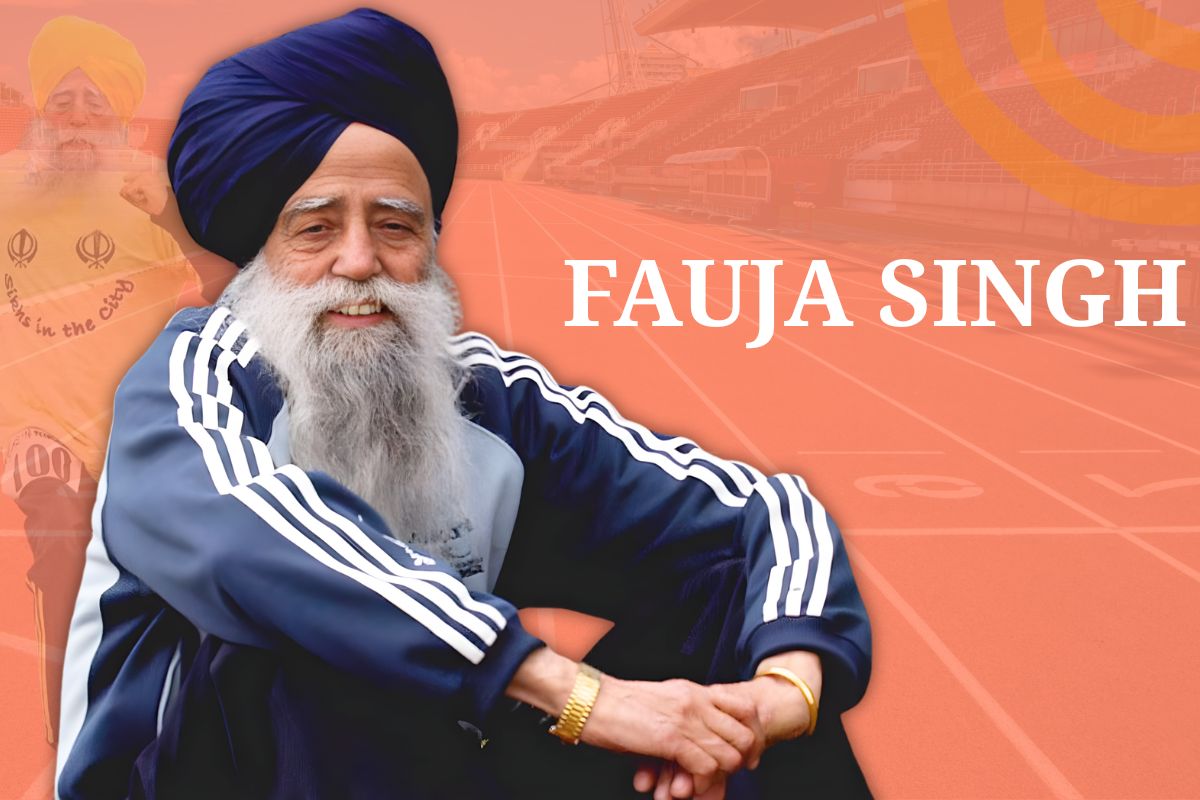
Fauja Singh, the 114-year-old marathon runner, died on July 14, 2025, in a hit-and-run accident in his village in Punjab, India. He was struck by an SUV as he crossed the road near his rice fields. He was 114 years old. His death made global news. India’s prime minister called him extraordinary. Running communities worldwide were devastated. But there was more to Fauja’s story than running marathons at an absurd age. It was about grief, starting over, and refusing to give up.
The Kid Who Couldn’t Walk
Fauja Singh was born on April 1, 1911, in Beas Pind, a village of farmers in Punjab. Birth certificates, of course, didn’t exist then, which later became an issue for people trying to verify his age. His childhood sucked. Fauja had been unable to walk until he was five. His legs were so feeble and puny that they could barely support him. Other children referred to him as danda, which means “stick” in Punjabi, because his legs looked like twigs. And that nickname stuck for a decade. No one had expectations for the boy who couldn’t walk. They were all wrong, and it took him eight decades to show it.
The Losses That Broke Him
For most of his life, Fauja was nothing more than a farmer. Cultivated rice and sugarcane in Punjab. Married, had children, farmed the land. He did a little bit of running in his youth but gave it up after the Partition of India in 1947. Then everything fell apart. His wife died in 1992. Two years thereafter, his fifth son, Kuldip, was killed in a construction accident during a storm. Fauja watched it happen. His eldest daughter had also succumbed in childbirth.
When Fauja’s elder son died, he went into depression. Couldn’t eat. Couldn’t sleep. His family feared he’d never recover. Fauja moved to England and joined one of his sons at Ilford, east London, in the 1990s. An 83-year-old man, shattered by grief, found himself in a foreign land where his English was little more than a rattle.
Starting Over at 89
In 2000, Fauja started running again when he was 89. He’d watched marathons on television, and something clicked. Perhaps running would chase away the grief. That’s where he met a coach, Harmandar Singh, and began training. He recalls his first practice well. Fauja showed up in a three-piece suit. Harmandar explained that running down the street in formal wear might attract police attention.
“Running has given me kindness and brought me back to life by making me forget all of my traumas and sorrows,” Fauja would say later. Two months is all he trained for before running the London Marathon in 2000. He finished in 6 hours and 54 minutes, beating the previous world record for 90-plus runners by 58 minutes. The British Sikh athlete became famous overnight.
Breaking Records Nobody Knew Existed
Fauja didn’t just run. He broke records that no one had ever dreamed of, let alone tried to break. He ran his personal best of 5 hours and 40 minutes at the 2003 Toronto Waterfront Marathon. It’s a time that is respectable even for runners half his age. When he became 100 years old, he did something absurd in 2011. He then proceeded to establish eight world age-group records in a single day in Toronto at the Ontario Masters Association Fauja Singh Invitational Meet. He competed in events from 100 meters to 5000 meters.
His 200-meter time was 52.23 seconds. His mile time was 11:53.45. His 5000-meter time was 49:57.39. Five world records in a day. The other three distances had no prior records; nobody his age had ever tried them. Three days after that, he became the first 100-year-old to complete an entire marathon on October 16, 2011. He ran the Toronto Waterfront Marathon in 8:11:06.
And he was 100 years old. Earlier that day, he’d run 26.2 miles. His accomplishments were never added to the Guinness World Records because he was unable to produce a birth certificate. His British passport listed his date of birth as April 1, 1911. Indian officials confirmed that birth records were not maintained in rural Punjab at the time. But everybody who watched him run knew it was true.
Also Read: Building a Startup Financial Model That Actually Works
More Than Running
Fauja became famous worldwide. He also bore the Olympic torch in Athens, 2004, and London, 2012. He starred in ads with David Beckham and Muhammad Ali. He was taken up as a model by Adidas. He ran marathons around the globe. New York, Toronto, Mumbai, Hong Kong. He always wore his trademark bright yellow turban. Always with that shuffle of a jog that nonetheless clocked 26.2 miles.
He leveraged his popularity to raise money for charity and promote Sikh culture. His running club, Sikhs in the City, competed in marathons alongside interfaith groups and raised money for various charitable causes. Indian youth looked up to him as a fitness role model. Here he was, a guy who took up exercising in his late 80s and went on to become world-famous.
The Simple Secret
People always wanted to know his secret. How does someone run marathons past 100? Fauja was 5 feet 8 inches and weighed 115 pounds. Never smoked. Never drank. Simple vegetarian diet. “Phulka (flatbread), dal, green vegetables, yoghurt, and milk,” he said.
His training philosophy was interesting. “The first 20 miles are not difficult. As for the last six miles, I run while talking to God.” His coach, Harmandar, said Fauja was the best student he ever had. Trained regularly, trusted his coach completely, and couldn’t tell a mile from a kilometre. Harmandar used that to his advantage. When they had miles left, he’d tell Fauja they were kilometres.
114-Year-Old Marathon Runner: Age and Retirement
Fauja competed in his final marathon in a competitive setting at the Hong Kong Marathon in February 2013. He was 101. He finished the 10K course in 1 hour, 32 minutes, and 28 seconds. He retired from competition then but stayed in the sport. He had been a special guest at marathons.
Made appearances at fitness events. In 2017, the Birmingham International Marathon named him as its honorary starter for its inaugural race at age 106. “I hope people will remember me,” he said after retiring. “I want people to continue to invite me to events rather than forget me altogether just because I don’t run anymore.” They remembered him. The oldest marathon runner in 2025 was still making news even after he stopped competing.
The Tragic End
On July 14, 2025, Fauja went to inspect his rice fields in the neighbouring village. A routine stroll that he had taken thousands of times. An SUV struck him on the Jalandhar-Pathankot highway. He lay on the road for several minutes until someone found him. They got him to Shrimann Hospital in the Jalandhar district, by which time he had bled too much. He suffered head and rib injuries and died. He was 114. The 114-year-old marathon runner’s cause of death was completely preventable. The driver, a 26-year-old man named Amrit Singh Dhillon, ran away from the scene. He turned his car off-road to dodge cameras, hid it in his garage, switched to biking, and acted normal. Police arrested him anyway.
A 114-year-old marathon runner died in what police are treating as a hit-and-run crime. The driver is being charged with failing to stop and assist Singh or take him to a hospital. Fauja’s family was surprised by how quickly the police moved on the case. “Hit and runs happen because people who have made a mistake think they can get away,” his nephew Parmeet Singh said. “He was a celebrity, so the media jumped on it,” the driver’s aunt told reporters. Otherwise, accidents happen all the time. ” She was right. More than 150,000 people die in road accidents in India annually.
The Response
Within hours, word of the 114-year-old marathon runner’s death had spread. His biographer Khushwant Singh also penned, ‘My Turbaned Tornado is no more. An automobile hit him in his home village of Beas as he was crossing the road. May you rest in peace, dear Fauja.” India’s prime minister, Narendra Modi, paid homage. “Fauja Singh was special because of his unique personality and the way he inspired a generation of Indians hugely interested in fitness.
Running communities worldwide mourned. He was one of the world’s rising stars, as Time Magazine included him in their 2025 100 Next. Even at 114, he continued to inspire others. Plans emerged to build a Fauja Singh Clubhouse on his training route. Indian sculptors started projects honouring his memory.
What Actually Matters
Fauja Singh’s story isn’t about running. It’s about starting over when life seems finished. Finding purpose after devastating loss. Proving that age is just a number if you’ve got determination. He couldn’t walk until he was five. People thought he was disabled. He ended up running nine full marathons and setting world records at 100. He started running at 89 to cope with grief and inspired millions.
He showed up at his first training in a three-piece suit and became the Turbaned Tornado. He grew up in rural Punjab, unable to walk properly and ended up carrying the Olympic torch. The 114-year-old marathon runner proved it’s never too late. Not to start exercising. Not to chase a dream. Not to rebuild after tragedy. Fauja once said, “From a tragedy has come a lot of success and happiness.” He took the worst things that can happen and turned them into something inspiring. His death in a hit-and-run was senseless, but his life was extraordinary. The kid who couldn’t walk became the centenarian who ran marathons.
Also Read: 12 Business Ideas That Actually Work (I’ve Seen Them Succeed)
Frequently Asked Questions
1. When did Fauja Singh start running marathons?
At 89, turning grief into purpose and movement into healing.
2. Why wasn’t Fauja Singh in the Guinness World Records?
He had no birth certificate; rural Punjab didn’t issue them in 1911, even though his age was widely accepted.
3. What made Fauja Singh’s achievements so special?
He finished full marathons at 100 years old, with age-group records and inspiring millions of people worldwide along the way.
4. What was Fauja Singh’s fitness routine and lifestyle?
Simple veggie diet, no alcohol, no smoking, daily discipline—and faith.
5. How did the 114-year-old marathon runner die?
He died in a hit-and-run accident on July 14, 2025, in Punjab, which was rather unfortunate given such a remarkable life.
6. Who sponsored Fauja Singh’s marathon running gear?
Fauja Singh was sponsored by Adidas, which provided his running gear and featured him in its famous “Impossible Is Nothing” campaign alongside global sports icons.





💬 Comments